🥛 How Long Does Raw Milk Last? A Practical, Honest Guide for Real Kitchens
✨ Quick Answer How Long Does Raw Milk Last
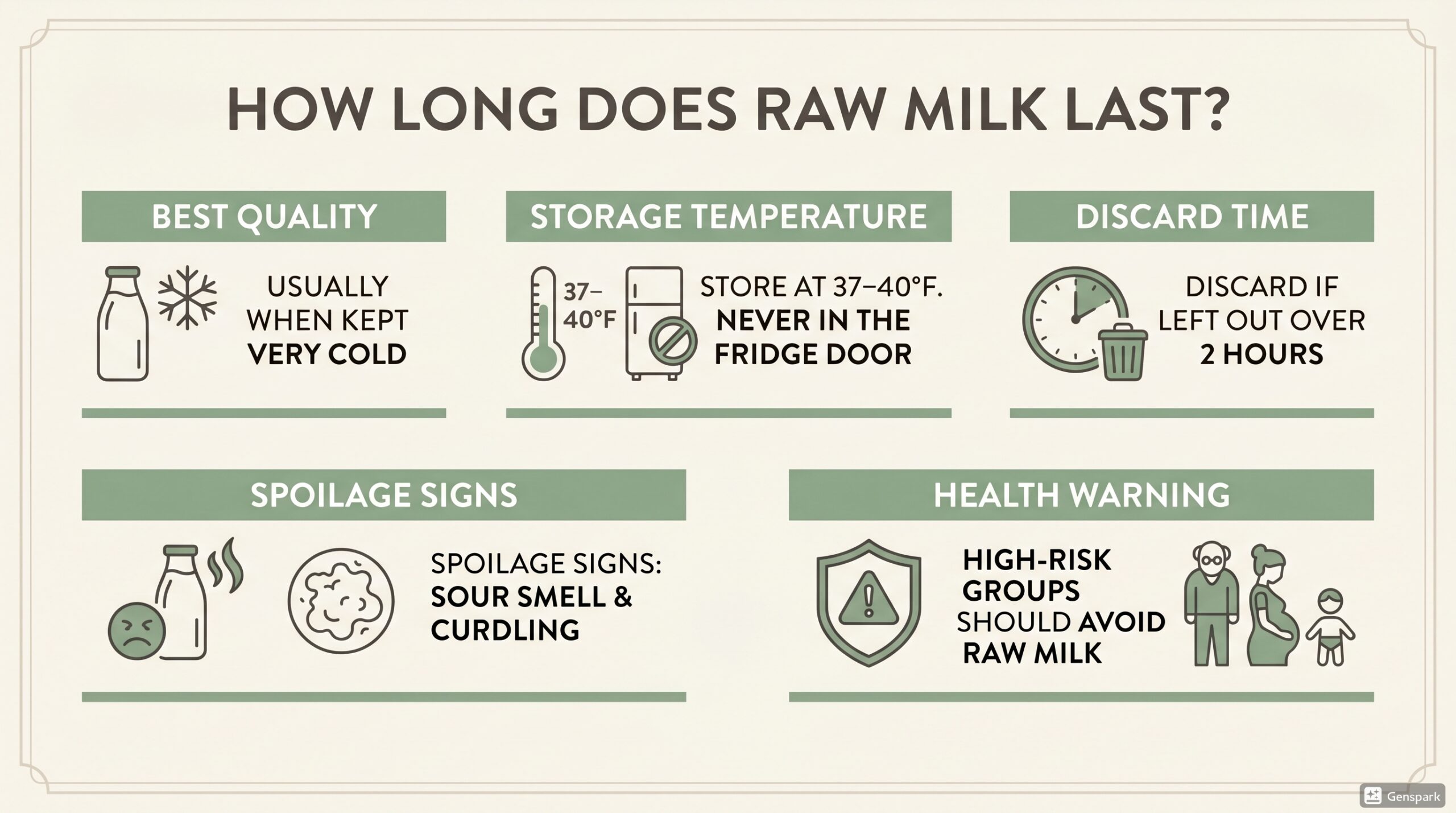
Raw milk usually lasts about 5 to 10 days in the refrigerator when it is kept consistently very cold, but there is no guaranteed shelf life because raw milk can spoil faster depending on how cleanly it was handled, how cold it stayed, and how old it was when you bought it. For best storage, keep it at 37°F to 40°F, never leave it out for more than 2 hours, and remember this important point: raw milk can contain harmful bacteria even before it smells or tastes bad. Clemson University Ohio State University Extension CDC USDA
🌿 Why this question How Long Does Raw Milk Last matters more than people think
If you’ve ever brought home a jar of raw milk, you probably asked yourself the same thing most people do:
“How long can I actually keep this before it goes bad?”
And honestly, it’s a fair question.
Raw milk feels more “farm fresh,” more natural, and in some households it’s treated almost like a premium food. But unlike pasteurized milk, it hasn’t gone through heat treatment to kill disease-causing germs. That means shelf life is not just about taste. It’s also about food safety, and that changes the conversation completely. FDA CDC
So if you’re looking for a simple, human answer, here it is:
Raw milk may stay drinkable for several days, but it is never as predictable or as safe as pasteurized milk.
That’s why the smartest approach is to think in terms of freshness, storage temperature, and risk, not just a number on the calendar. Ohio State University Extension USDA
🧊 The realistic shelf life of raw milk in the fridge
In most home kitchens, raw milk lasts around 5 to 10 days if it is refrigerated immediately and kept cold the entire time.
Some people say their raw milk lasts longer, especially when it comes from a very clean source and is rapidly chilled after milking. That can happen. But from a practical reader-first perspective, it’s smarter not to treat the longest possible shelf life as the normal one. Temperature swings, transport time, opening the container often, and storing milk in the fridge door can all shorten how long it stays fresh. Clemson University Ohio State University Extension
The safest rule of thumb is this:
- Best quality: first few days
- Typical home-fridge window: about 5 to 10 days
- Only if kept very cold and carefully handled: sometimes longer
- Never assume it’s safe just because it still looks fine USDA FDA
That last point matters a lot. Harmful bacteria do not always change the smell, taste, or appearance of food. So raw milk can be risky before it gives you an obvious warning sign. USDA
⚠️ Why raw milk doesn’t have one fixed expiration date
Here’s where many blog posts oversimplify things.
Raw milk doesn’t last the same amount of time for everyone because its shelf life depends on several real-world factors:
1. How clean the milking process was
Even with careful farm practices, contamination can still happen. Raw milk can carry germs such as Salmonella, E. coli, Listeria, Campylobacter, Brucella, and Cryptosporidium. CDC FDA
2. How fast it was cooled
Cold temperatures slow bacterial growth. If milk was not chilled quickly or warmed up during transportation, its usable life drops fast. CDC USDA
3. Where you store it in the fridge
Milk stored in the refrigerator door warms up every time the door opens. Ohio State specifically notes that milk should be kept in a colder section of the fridge, not the door. Ohio State University Extension
4. How often the container is opened
Every pour exposes milk to warmer air and outside bacteria. That doesn’t mean you need to treat it like a science experiment, but repeated handling does matter.
5. Whether you’re tracking freshness or safety
This is the big one. A food can seem fresh enough to drink and still be unsafe. That’s especially true with raw dairy. FDA USDA
✅ Best way to store raw milk
If you decide to keep raw milk at home, storage matters more than almost anything else.
Keep it between 37°F and 40°F
Ohio State recommends storing milk in a part of the fridge that stays around 37°F, while CDC and USDA recommend keeping perishables at 40°F or colder. In plain English, colder is better, as long as the milk is not repeatedly warming up and cooling down. Ohio State University Extension CDC USDA
Store it on a lower back shelf
That’s usually the coldest, most stable part of the fridge.
Don’t keep it in the fridge door
This is one of the most common mistakes. The door is convenient, but it’s also the warmest and most temperature-unstable zone. Ohio State University Extension
Use clean containers and keep them sealed
The less outside contamination, the better.
Pour only what you need
Clemson advises pouring milk into a separate serving container rather than letting the original container sit out, and not returning milk that has been left out back into the original container. That’s a simple habit that can help preserve freshness. Clemson University
👃 How to tell if raw milk has gone bad
This is usually the moment people trust their senses.
Sometimes that works. Sometimes it doesn’t.
If raw milk is clearly spoiled, you’ll often notice one or more of these signs:
- a sour or unpleasant smell
- clumping or curdling
- separation that looks unusual or chunky rather than a simple cream line
- a thicker, slimy, or ropy texture
- off taste
If something looks or smells suspicious, FDA guidance is straightforward: throw it out. FDA
But here’s the part many readers need to hear twice:
Spoilage signs are not the same as safety signs.
Disease-causing bacteria may grow without changing the taste, smell, or appearance in an obvious way. So “it smells okay” is not a reliable safety test for raw milk. USDA
That means if you’re on the fence, the safest move is not to “give it one more day.” It’s to discard it.
⏰ What if raw milk was left out on the counter?
This one has a clear answer.
Raw milk should not sit out for more than 2 hours at room temperature. If the room or outdoor temperature is above 90°F, that window shrinks to 1 hour. After that, bacterial growth can accelerate fast. CDC FDA USDA
And no, putting it back in the refrigerator later does not erase what happened.
Once a perishable food spends too much time in the “danger zone” between 40°F and 140°F, bacteria can multiply rapidly, and some can double in as little as 20 minutes. USDA
So if your raw milk sat in the car, on the counter, or at a picnic table too long, it’s better not to gamble.
❄️ Can you freeze raw milk?
Yes, you can freeze raw milk.
Clemson notes that milk can be frozen at 0°F for up to three months and still be safe to drink if thawed in the refrigerator, although quality may decline. That “quality may decline” part usually means texture changes, separation, or a less pleasant mouthfeel after thawing. Clemson University FDA
If you freeze it, leave some headspace in the container because liquids expand. Then thaw it in the refrigerator, not on the counter.
Freezing is a practical option if you bought more than you can use quickly, but it’s better for cooking, baking, or blending than for that just-poured fresh-milk experience.
🧠 A smart, reader-first bottom line
If you want the most honest answer possible, here it is:
Raw milk may last around 5 to 10 days in a very cold fridge, but safety is never guaranteed by smell, taste, or appearance alone.
That’s why the safest strategy is to:
- chill it immediately
- keep it at 37°F to 40°F
- store it away from the fridge door
- use it quickly
- discard it if it sat out too long
- never rely only on your nose to judge safety CDC USDA Ohio State University Extension
For pregnant women, children under 5, older adults, and people with weakened immune systems, health agencies strongly advise avoiding raw milk altogether because the risk of serious illness is higher. CDC FDA
❓ 10 FAQs About How Long Does Raw Milk Last
1) How long does raw milk last after opening?
Raw milk does not suddenly “start expiring” after opening the way people sometimes imagine. In reality, opening the container exposes it to air, warmer temperatures, and whatever bacteria may be on your hands, cup, or kitchen surfaces. So once it’s opened, the practical shelf life depends heavily on how carefully it is handled.
If it stays cold and clean, many people use it within 5 to 10 days total from the time they got it, not 5 to 10 extra days after opening. The safest habit is to treat opening as a signal to use it sooner, not later. Keep pours quick, return the container to the fridge immediately, and don’t let it linger on the counter. Clemson University CDC
2) Is raw milk still safe if it smells normal?
Not necessarily.
This is one of the biggest misconceptions around raw dairy. A normal smell is not proof of safety. USDA explains that pathogenic bacteria may grow without noticeably changing taste, smell, or appearance. That means raw milk can look and smell fine and still carry germs that make people sick. USDA
So if you are deciding whether milk is safe based only on a sniff test, you are missing the bigger risk. Smell can help you spot obvious spoilage, but it cannot certify safety.
3) Does raw milk last longer than pasteurized milk?
In normal home use, usually no.
Some raw milk enthusiasts claim it lasts longer because it sours naturally rather than “going bad” in the same way as pasteurized milk. But from a food safety perspective, pasteurization exists for a reason: it reduces harmful germs and improves predictability. FDA and CDC are clear that pasteurized milk offers the nutritional benefits of milk without the same raw-milk risk profile. FDA CDC
Even if a batch of raw milk seems to keep well, that does not mean it is safer or more stable overall.
4) Can I drink raw milk after 7 days?
Maybe, but only if it has been handled extremely well and kept consistently cold.
Seven days is within the range many households consider possible for refrigerated raw milk. But that does not make day seven a universal green light. You still need to think about transport time, fridge temperature, handling, and whether the milk was fresh when you got it.
If you know it warmed up during pickup, sat out during breakfast more than once, or has any suspicious smell or texture, don’t push it. And if anyone in your home is pregnant, elderly, immunocompromised, or very young, it’s not worth the gamble. CDC FDA
5) What is the best temperature for storing raw milk?
The ideal target is very cold refrigeration, roughly 37°F to 40°F.
Ohio State notes milk should be stored in the fridge around 37°F and not in the door, while CDC and USDA recommend 40°F or colder for perishables. In real life, that means using the coldest stable section of your refrigerator and checking your appliance temperature if you are serious about storage quality. Ohio State University Extension CDC USDA
A fridge that “feels cold enough” is not always cold enough.
6) Can raw milk make you sick even before it spoils?
Yes.
That is exactly why public health agencies are so direct about raw milk. It can contain harmful organisms such as E. coli, Salmonella, Listeria, Campylobacter, Brucella, and Cryptosporidium. These germs may be present before obvious spoilage develops. CDC FDA
This is the key difference between “freshness” and “safety.” A product can be fresh enough to drink from a taste standpoint and still be unsafe from a microbiological standpoint.
7) Should raw milk be stored in glass or plastic?
The bigger issue is not the material. It’s the cleanliness, seal, and temperature stability.
A clean glass jar works well because it is easy to sanitize and doesn’t hold odors. A food-safe plastic container can also work if it seals tightly and is kept cold. What matters most is that the container is clean, closed, and not repeatedly exposed to warm air. Also, don’t pour leftover milk back into the main container after it has been sitting out. Clemson University
So if you are choosing between “pretty jar” and “safe routine,” always choose the safe routine.
8) Can I use sour raw milk for cooking or baking?
People often do, but that does not automatically make it safe.
If milk is merely turning sour from age, some home cooks may use it in pancakes, biscuits, or baked goods. But if the milk is raw, you still have the same underlying issue: you cannot know by smell alone whether harmful germs are present. Heat in cooking may reduce some risks, but relying on random leftover raw milk for safety is not a strong food-safety strategy.
If there is any doubt about how long it sat out, how warm it got, or how it smells and looks, discard it rather than trying to “save” it in a recipe. USDA FDA
9) Who should not drink raw milk?
According to CDC and FDA, the people at highest risk are:
children under 5
pregnant women
older adults
people with weakened immune systems CDC FDA
For these groups, raw milk is not a “personal preference” issue as much as a health-risk issue. Listeria in particular is a major concern during pregnancy. If someone in your home falls into one of these categories, avoiding raw milk is the most cautious route.
10) What’s the safest rule if I’m unsure whether raw milk is still good?
When in doubt, throw it out.
That sounds simple because it is. If the milk has been out too long, if your fridge temperature is uncertain, if the container was repeatedly left open, or if anything about the smell, texture, or appearance feels off, don’t try to talk yourself into using it.
Foodborne illness is a lousy price to pay for finishing a jar of milk. FDA says suspicious-looking or suspicious-smelling food should be discarded, and CDC and USDA emphasize strict cold storage and the two-hour rule for perishables. FDA CDC USDA
📌 Final takeaway
If you want one sentence to remember, make it this:
Raw milk may last roughly 5 to 10 days in the fridge, but safe storage depends on cold temperature, careful handling, and understanding that harmful bacteria may be present even before spoilage becomes obvious. CDC FDA USDA